









4517 Washington Ave. Manchester, Kentucky 39495
info@ammioaisupport.co.uk
+44 20 8980 9731

4517 Washington Ave. Manchester, Kentucky 39495
info@ammioaisupport.co.uk
+44 20 8980 9731

DataNimbus
DataNimbus DataNimbus

Blog

How Event-Driven Architecture Drives Real-Time Decision Making in Enterprises

Introduction:

Remember that time you were showing your boss a “real-time” dashboard, and you both stood there awkwardly watching the loading icon spin? Well, folks, welcome to the world of event-driven architecture (EDA), where “real-time” actually means real-time, and not “let’s-grab-a-coffee-while-this-loads” time.

October 2025 | Blog

What is Event-Driven Architecture?

At its core, event-driven architecture is like a really efficient party planner for your data. It’s all about reacting to “events” as they happen. An event could be anything from a customer placing an order to your cat walking across your keyboard (though I’m not sure how useful that second one is for business decisions). Unlike traditional request-response systems, EDA is loosely coupled and focuses on the flow of events, enabling systems to act dynamically as new data arrives.

Key components include:

  • Events: The “OMG, something happened!” moments in your system
  • Event producers: The drama queens of your architecture, always making a       scene
  • Event consumers: The gossip who can’t wait to hear and react to the latest       news This setup allows systems to respond to real-time events faster than        you can say “Why is the system so slow?”

Transition to ELT: Why the Change Was Necessary

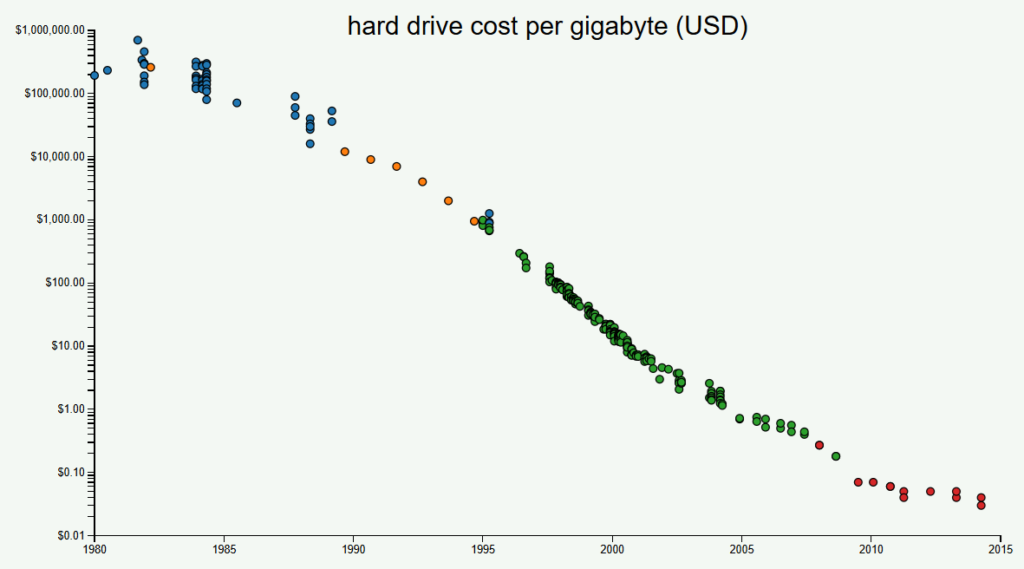
As cloud platforms such as AWS, Azure, and GCP have made large-scale data storage much more affordable, the industry needed to adapt to cloud-based solutions. ELT (Extract, Load, Transform) reversed the traditional model:

  • Instead of processing data externally, you load raw data first and then transform it at scale using distributed computing engines like Spark, enhancing the data processing capabilities.
  • The approach naturally supports unstructured and semi-structured data, aligning perfectly with modern, large-volume workloads  in the modern data stack.

With ELT, big data projects can grow without hitting the resource limits of dedicated ETL engines. This shift has allowed organizations to manage streaming data, perform interactive analytics, and integrate various data sources more seamlessly than ever before.
ETL vs ELT: Side-by-Side Comparison

With so much buzz around modern cloud platforms and the rise of ELT Solutions, it begs the question: Is ETL Process truly a thing of the past? Let’s examine the fundamental differences between these approaches to see why each still has its place.

To understand the fundamental differences between ETL and ELT, here’s a brief comparison that emphasizes the unique advantages of each method in the context of data transformation:
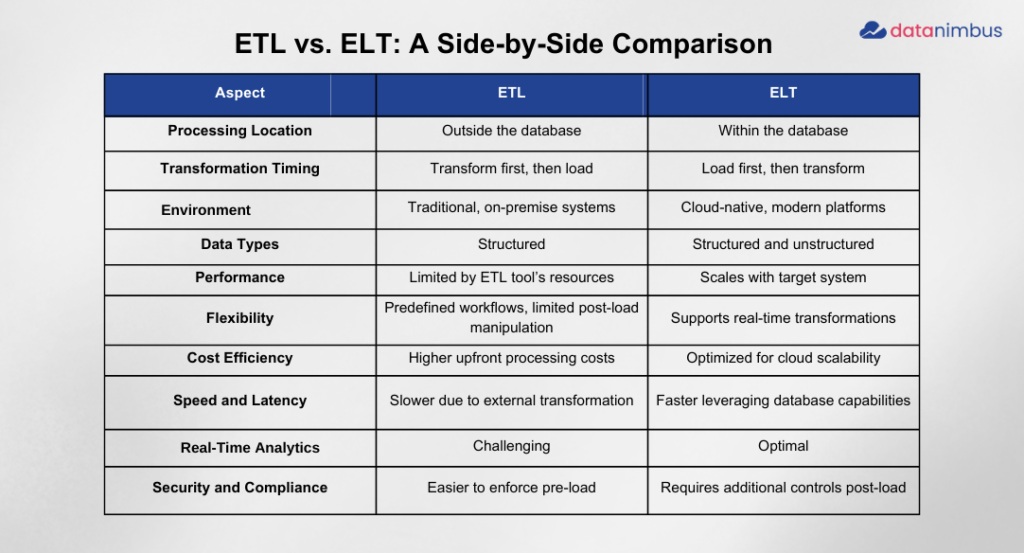
Key Takeaway:  Understanding the key differences between ETL and ELT can greatly impact your data strategy. ETL still excels in scenarios where data quality and compliance checks are crucial before data is stored. Conversely, ELT is more suitable for high-volume, flexible, or rapidly changing datasets, especially in cloud environments.


ETL vs. ELT: What Works Best for Which Use Case?

Now, let’s relate these differences to the real world scenarios:

ETL Use Cases

  • Regulated Industries (e.g., healthcare or finance) need strict data governance and pre-load transformations to comply with       the ETL process.
  • Legacy Systems or on-premises environments with limited compute power often struggle with modern data processing       needs.
  • Consistent schemas are where transformations rarely change, and data volume is relatively stable.

ELT Use Cases

  • Large-scale, Cloud-Native ecosystems handling diverse, semi-structured, or unstructured data.
  • Real-Time and On-Demand Analytics where quick insight is key.
  • High Scalability Needs, such as streaming data pipelines or dynamic reporting dashboards.

The Databricks Perspective and DataNimbus Designer

Modern cloud platforms like Databricks have made ELT incredibly efficient with distributed storage (e.g., Delta Lake) and compute engines (e.g., Spark or Databricks SQL). However, many organizations still rely on classic ETL for part of their data while also wanting ELT’s flexibility for newer or evolving data needs. DataNimbus Designer tackles this challenge by offering:

  • Flexibility to manage both ETL and ELT in one place, so you can serve legacy systems and modern data lakes without        juggling multiple tools.
  • Cloud-Native Integration for smooth transformations within platforms like Databricks.
  • Operational Efficiency with built-in automation, monitoring, and streamlined pipeline management.
Imagine an e-commerce company migrating from on-premises systems to the cloud. They still require ETL to comply with payment-processing regulations but also wish to perform near-real-time analytics on clickstream data using ELT. DataNimbus Designer enables them to manage both in a unified manner: a traditional ETL pipeline for billing data alongside an ELT pipeline for high-volume clickstream analysis.

Conclusion: A Hybrid Future for Data Integration

As data volumes increase and enterprises adopt the cloud, ELT methods will continue to gain momentum due to their scalability and flexibility. However, ETL remains crucial for situations that require stringent quality checks, high compliance levels, or integration with legacy systems.

The bottom line is that the ETL process must evolve to meet modern data requirements: It’s not about permanently selecting one approach; it’s about choosing the right tool for each task. Platforms like Databricks and tools like DataNimbus Designer enable teams to implement a hybrid strategy, blending ETL and ELT techniques to suit each workflow’s specific needs in the modern data stack.

Ready to discover the best of both worlds? Contact us to learn how DataNimbus Designer can future-proof your data pipelines, enhance operational efficiency, and help you derive more value from your data.

Cart (0 items)

Ready to Get Started

Location

Would you like to join our growing team?

Phone No

We’re interested in working together

Create your account