Break free from legacy! Modernize your core with intelligent, AI-powered solutions
In today’s data-driven world, platforms must efficiently process and analyze vast amounts of information to deliver actionable insights. Real-time data processing has gained prominence for applications demanding immediate results, such as anomaly detection, financial monitoring, and personalized user experiences. However, batch processing remains a dependable choice for periodic, large-scale tasks like report generation, data backups, and complex data transformations.
Choosing between real-time and batch processing is not always straightforward; It depends on your system’s requirements, scalability goals, and operational complexities. Real-time processing ensures low latency for critical tasks, while batch processing optimizes resource use for operations that can tolerate delays. We will explore the strengths and trade-offs of both approaches to make informed decisions for data management strategy.

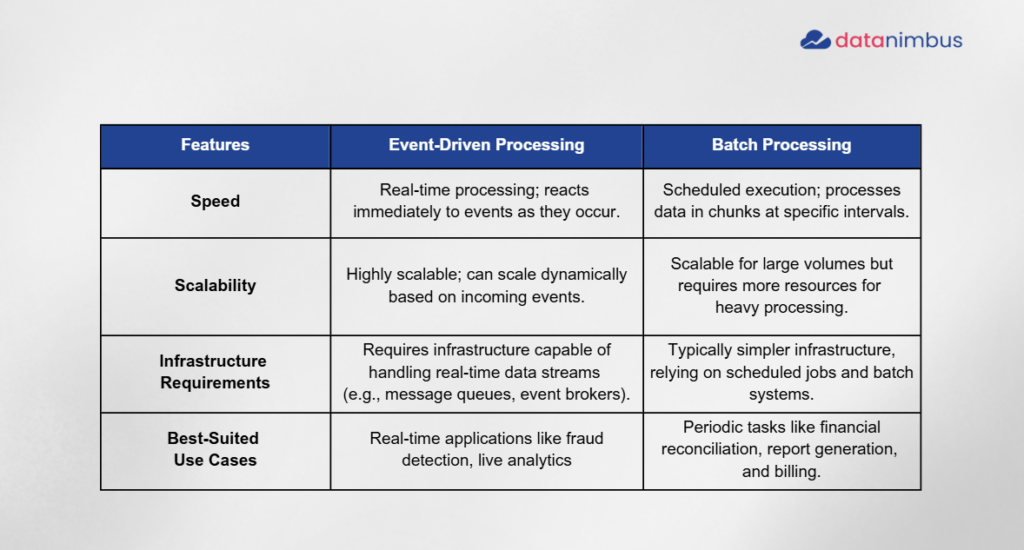
Event-driven processing focuses on a model that responds to events as they occur, triggering actions in real-time based on specific conditions. It enhances responsiveness and scalability by decoupling event producers from consumers, making it ideal for applications like real-time analytics, IoT, and microservices.
Event-driven architecture empowers businesses to build responsive, fault-tolerant, and efficient applications.
For example, financial institutions handle millions of transactions daily, making fraud detection a critical yet challenging task. Event-driven processing enables real-time monitoring and rapid response to suspicious activities. Capturing real-time events from multiple sources—such as payment gateways, ATM withdrawals, or online banking—helps identify anomalies based on predefined patterns or AI models, triggering alerts when suspicious activity is detected.
Batch processing involves executing tasks on large datasets in groups (or batches) at scheduled intervals rather than in real time. This makes it ideal for back-office operations where efficiency is more important than real-time execution, such as generating reports, processing payroll, or performing system backups.
For example, a financial institution doing reconciliation will have to compare transactions from multiple sources, such as bank statements and internal records. Batch processing automates this task by fetching and comparing large datasets at scheduled intervals. Discrepancies are flagged for review, and detailed reports are automatically generated. This approach saves time, reduces human error, and improves accuracy.