Break free from legacy! Modernize your core with intelligent, AI-powered solutions
And how DataNimbus FinHub Ledgers helps you automate sub-accounting, control compliance, and scale financial operations.
Today’s finance leaders oversee operations that move faster and span wider than ever before. A CFO may be tracking budgets across multiple business units, while the operations team ensures smooth payouts to vendors, manages branch-level flows, and keeps every transaction aligned with compliance.
In high-volume, high-velocity environments — from marketplaces with thousands of merchants, to lenders disbursing funds in real time, to escrows with dynamic multi-party agreements — the traditional single-account structure often limits visibility and flexibility.
What’s needed is an approach that provides granularity, programmability, and confidence at every level of financial activity.
That’s where sub-accounting comes in — serving as the foundation that gives modern organizations the clarity and control they need to scale.
Sub-accounting transforms the way you manage money by enabling
Separation of Funds
Keep obligations, use-cases, or clients financially isolated — without co-mingling funds.
Real-Time Visibility
Monitor balances at the most granular level — by merchant, borrower, milestone, or purpose.
Automated Compliance
Each sub-account can carry its own set of rules, limits, and audit trails — dramatically simplifying compliance.
Programmable Actions
Set fund movements to follow your business logic — e.g., release a payout only when a milestone is reached.
Strategic Insights
Get deep visibility into performance, utilization, and risk —insights you can’t unlock from a single consolidated account.
Sub-accounting is the practice of creating logical partitions within a single master account — each with its own balance, purpose, and rules. Think of it as setting up dedicated “financial containers” inside your ledger: one for each project in a real estate deal, one for every merchant in a marketplace, one for each business unit in a corporate budget, or even one for every escrow condition in a settlement. This structure provides the same clarity and separation as opening multiple accounts, but without the overhead of managing them individually.

Legacy ERPs and accounting platforms were designed for record-keeping, not today’s real-time, high-volume financial activity. They can tell you the balance — but they can’t define how that balance should behave.
Modern businesses need real-time visibility into transactions, the ability to manage multi-party flows, and programmable rules that adapt to evolving business models.
Traditional tools provide the foundation, but sub-accounting builds on top of it — offering the flexibility, granularity, and automation required for dynamic environments like digital marketplaces, large-scale project finance, or real-time lending.
FinHub Ledgers is built to make sub-accounting programmable, intelligent, and effortless for your business.
Here’s what sets it apart:
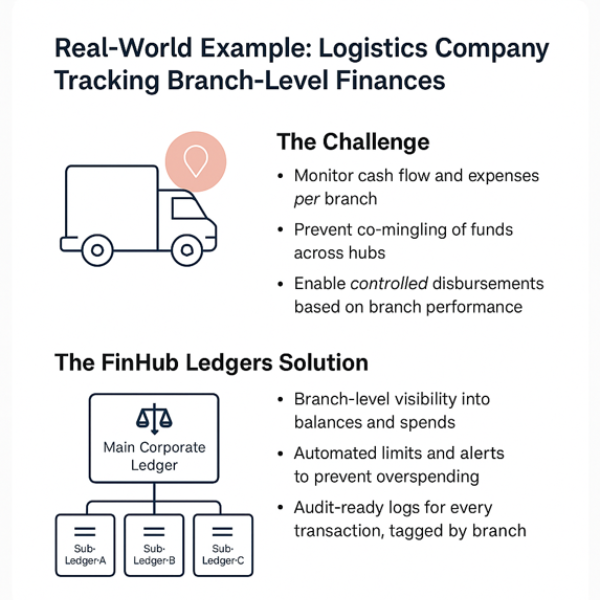
A national logistics company operates hundreds of delivery hubs across the country. Each hub handles local collections, payouts to delivery partners, and operational expenses.
With DataNimbus FinHub Ledgers, the company created a single corporate ledger and set up a sub-ledger for each logistics hub.
Each sub-ledger:
The Outcome
For fast-moving businesses, agility isn’t optional — it’s a competitive advantage.
Sub-accounting gives you the clarity, compliance, and control you need to scale confidently, whether you’re running a marketplace, managing escrows, disbursing loans, or orchestrating multi-department budgets.
With DataNimbus FinHub Ledgers, you don’t just track balances. You program your money flows — and manage your financial operations with speed, precision, and confidence.